Best sprayer for cabinets: Ottawa homeowners' guide

TL;DR:
HVLP sprayers provide a fine finish with less overspray, ideal for detailed cabinet work.
Proper surface preparation and technique are more crucial than equipment quality for professional results.
Budget HVLP models like HomeRight Super Finish Max and Wagner FLEXiO 590 are suitable for DIY kitchen cabinet refinishing.
Not all paint sprayers produce the same results on kitchen cabinets, and assuming otherwise is one of the most common mistakes Ottawa homeowners make before starting a refinishing project. The difference between a seamless, factory-finished look and a blotchy, uneven surface often comes down to one decision: which sprayer you use and how you use it. Whether you’re hoping to modernize your kitchen on a budget or simply want to avoid the cost of full cabinet replacement, understanding your equipment options puts you in control. This guide walks you through everything you need to know, from sprayer technology to technique, so you can finish like a pro.
Table of Contents
Key Takeaways
Point | Details |
HVLP is best | HVLP sprayers provide a smooth, modern finish with minimal mess on cabinets. |
Choose affordable models | Reliable HVLP sprayers like HomeRight and Wagner offer quality on a budget. |
Prep is crucial | Thorough cleaning, sanding, and priming is 50-70% of a great cabinet finish. |
Match technique to tool | Select the right sprayer and use proper thinning and method for professional results. |
Why HVLP sprayers are the top choice for cabinets
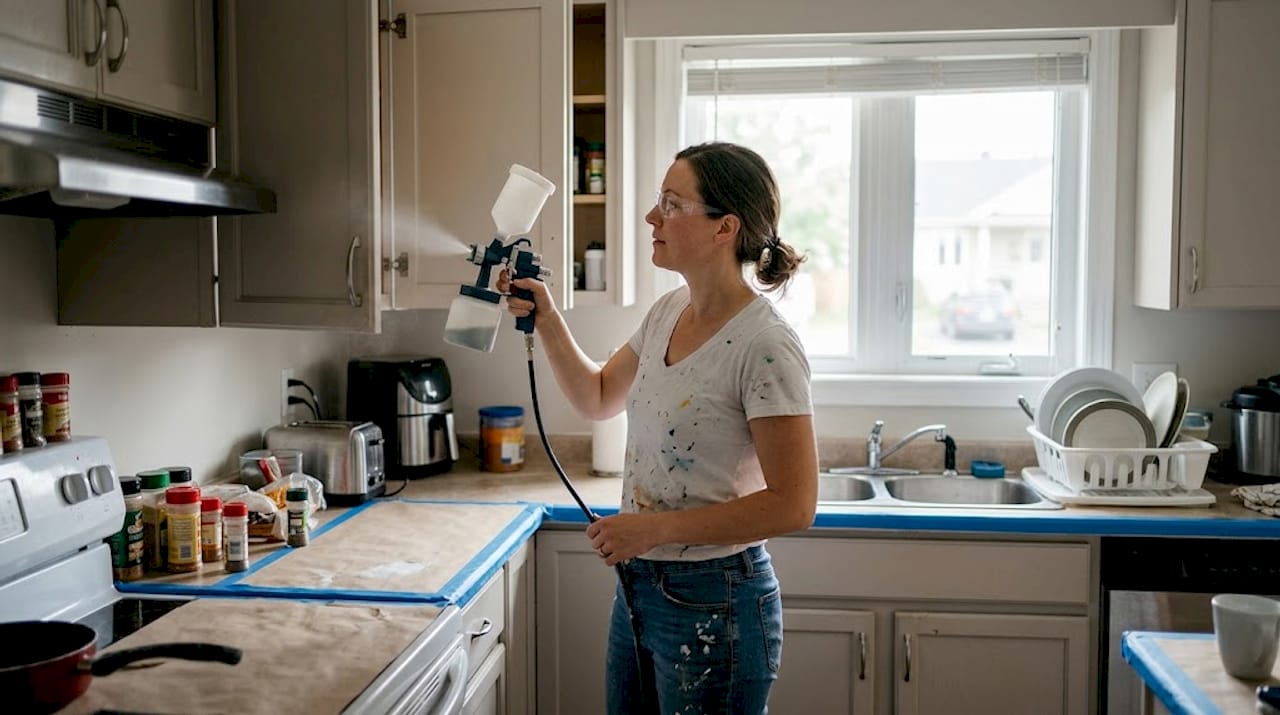
When it comes to kitchen cabinet refinishing, not all sprayer technologies are created equal. HVLP stands for High Volume Low Pressure, and that name tells you a lot about why it works so well indoors. The low-pressure delivery system atomizes paint into a fine, controlled mist rather than blasting it at high speed. That means less bounce-back, less overspray drifting onto your countertops, and far more paint actually landing on your cabinet surfaces.
For Ottawa homeowners working in a kitchen environment, that level of control is invaluable. You’re not painting a barn. You’re refinishing detailed door frames, recessed panels, and tight corners where precision matters. HVLP sprayers are best for kitchen cabinets due to fine finish, minimal overspray, and control on details. That’s not just marketing language. It reflects a genuine advantage in real-world residential settings.
One of the most important numbers to know is transfer efficiency, which refers to how much of the paint you spray actually ends up on the surface. HVLP systems consistently deliver over 80% transfer efficiency, meaning very little paint is wasted. Compare that to older or less precise technologies, and the difference in material cost alone adds up fast across a full kitchen.
“HVLP achieves a factory-like finish on cabinets; professionals use it for detail work, while airless sprayers are reserved for production speed.”
Airless sprayers, by contrast, push paint at very high pressure. They’re faster, no question, but that speed comes with trade-offs. Overspray is harder to control, cleanup takes longer, and the finish can look rougher on fine woodwork. For a kitchen setting where you want a showroom look, airless technology is generally overkill and harder to manage.
Here’s what HVLP does especially well for cabinets:
Delivers smooth, even coats on flat and recessed surfaces
Reduces paint waste with high transfer efficiency
Minimizes mess and cleanup time indoors
Gives you more control over fine details and edges
Works well with water-based cabinet enamels and latex paints
For more on how spraying cabinets for a smooth finish actually works in practice, we’ve covered the full process in detail.
Pro Tip: Before touching a single cabinet door, spray a test pattern on a piece of cardboard. Adjust the fan width and fluid control until the pattern looks even and consistent. This two-minute step saves you from fixing runs and blotches later.
Comparing popular sprayer options: HVLP vs. airless
With HVLP favored for detail and indoor projects, some wonder when an airless sprayer might actually be worth it. The honest answer is that it depends on your project size, the paint you’re using, and your tolerance for cleanup.
Here’s a direct side-by-side comparison:
Feature | HVLP | Airless |
Finish quality | Smooth, fine finish | Adequate but rougher |
Overspray | Low | High |
Speed | Moderate | Fast |
Cost (entry level) | $60 to $200 USD | $200 to $400+ USD |
Indoor suitability | Excellent | Poor to moderate |
Paint thinning needed | Usually yes | Often not required |
Best for | Cabinets, trim, detail | Large walls, exteriors |
Airless sprayers are better for speed and large areas but produce higher overspray and are less suited for detailed cabinet work. That’s a critical distinction for anyone working in a kitchen where appliances, countertops, and flooring all need protection.
There are edge cases where airless makes sense. If you’re working with a very thick cabinet enamel that HVLP equipment struggles to atomize properly, an airless unit can spray it unthinned. HVLP typically requires you to thin paint by 5 to 10% to achieve the right viscosity for smooth atomization. If you skip that step with HVLP, you’ll see orange peel texture or inconsistent coverage.
For most Ottawa homeowners refinishing a standard kitchen, HVLP is the clear winner. You get better control, a finer finish, and far less mess to manage. The dustless spraying for cabinets approach we use professionally takes this even further, but for a solid DIY result, a quality HVLP unit gets you most of the way there.
Scenarios where each option makes more sense:
HVLP: Standard kitchen cabinets, water-based enamels, indoor projects, first-time DIYers
Airless: Very large kitchens, oil-based or thick paints, experienced users comfortable with overspray management
Best affordable sprayer models available in Ottawa
Once you understand which technology fits your project, the next step is choosing a reliable, affordable sprayer you can actually find and buy.
Here are three models worth knowing about:
Model | Price (approx.) | Type | Where to buy |
HomeRight Super Finish Max | ~$60 USD | HVLP | Amazon, Home Depot |
Wagner FLEXiO 590 | ~$190 USD | HVLP | Home Depot Ottawa, Amazon |
Graco TrueCoat 360 | ~CAD$280 | Airless | Home Depot Canada |
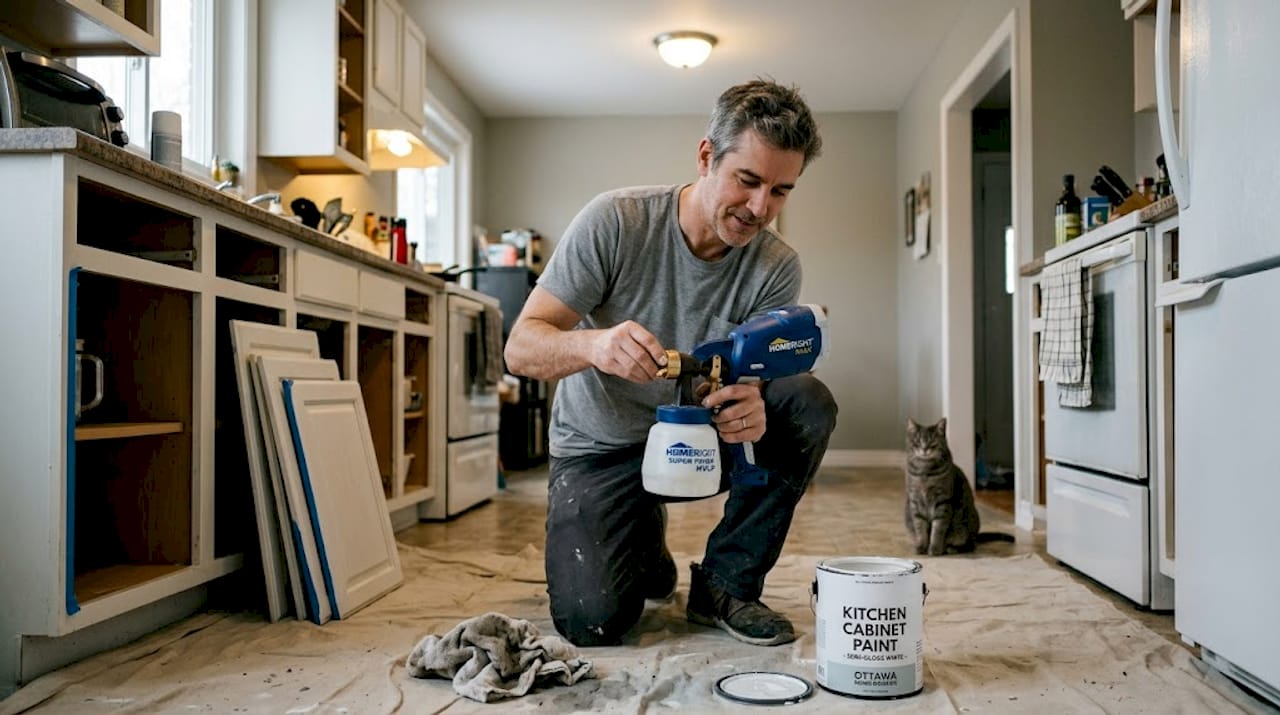
Top affordable HVLP picks include the HomeRight Super Finish Max at around $60 USD and the Wagner FLEXiO 590 at around $190 USD. Both are widely available and have a manageable learning curve for homeowners who haven’t sprayed before.
The HomeRight Super Finish Max is a solid entry point. It handles water-based cabinet paints well, has adjustable settings, and the price makes it easy to justify for a one-time kitchen project. The Wagner FLEXiO 590 steps things up with better atomization and a more refined finish, making it a favorite among serious DIYers.
For larger kitchens or tougher enamels, the Graco TrueCoat 360 is available in Canada at around CAD$280. It’s a handheld airless unit, which gives you more power than HVLP while remaining manageable for a homeowner. It’s not our first recommendation for standard cabinet work, but it’s worth knowing about for larger or more demanding projects.
All three models are available at Home Depot locations in Ottawa, which makes returns and in-person support accessible if you run into issues.
Look for adjustable fan width and fluid control on any model you choose
Check that the unit is compatible with the paint viscosity you plan to use
Consider whether the model includes a cleaning kit or extra tips
If you’re unsure whether DIY is the right call, it helps to understand cabinet painter availability in Ottawa and what a professional service actually includes. For those ready to skip the equipment research entirely, our cabinet spraying services in Ottawa cover the full process from prep to final coat.
Must-know techniques for a professional-looking cabinet finish
Getting the right tool is only half the equation. Using the right techniques makes all the difference between a result you’re proud of and one you want to redo.
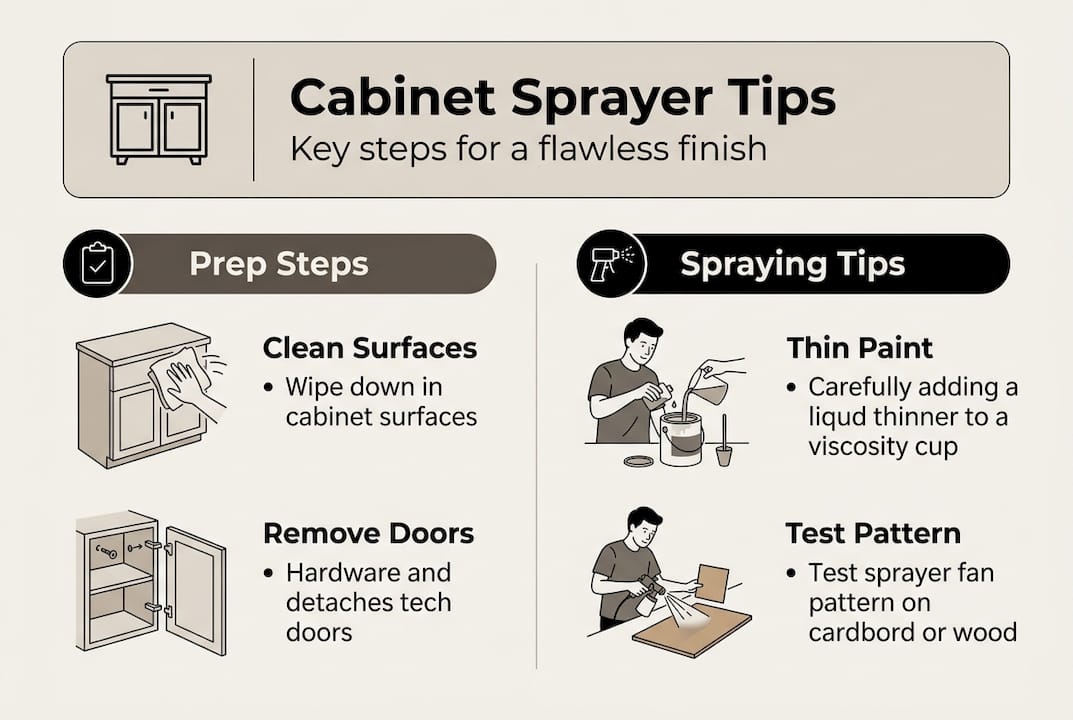
Here’s the honest truth: surface prep takes 50 to 70% of your total project time, and that’s exactly how it should be. Rushing prep is the most common reason DIY cabinet finishes fail.
Follow this sequence:
Remove all cabinet doors and hardware. Label each door so reinstallation is easy.
Degrease every surface. Kitchen cabinets collect grease and cooking residue that will prevent paint adhesion. Use a TSP substitute or dedicated degreaser.
Sand lightly. A 150-grit scuff sand creates tooth for the primer to grip. Don’t skip this, even on smooth surfaces.
Apply a quality primer. A shellac-based primer seals stains and knots, and gives you a reliable base coat.
Thin your paint correctly. For HVLP, thin paint 5 to 10% and maintain a 6 to 8 inch spraying distance with overlapping passes. Practice on scrap material first.
Apply two to three thin coats. Allow proper dry time between coats. Thin coats build a smoother, harder finish than one thick coat.
Sand lightly between coats. A 220-grit sand between coats knocks down any dust nibs and keeps the surface silky.
For more guidance on painting cabinets economically without sacrificing quality, we’ve put together a detailed walkthrough. And if you’re working with older wood, our notes on refinishing wooden cabinets cover the extra steps needed for a modern, durable result.
“Skipping primer or rushing dry time between coats is a recipe for disaster. The finish may look fine at first, but it will chip, peel, or yellow far sooner than it should.”
Pro Tip: Work in natural light whenever possible. Artificial lighting hides thin spots and missed areas that become obvious once the cabinets are back in place and daylight hits them. Always mask surrounding surfaces generously before you start spraying.
Common mistakes to avoid:
Skipping the practice run on scrap material
Using paint straight from the can without checking viscosity
Applying coats that are too thick, which causes runs and sagging
Neglecting to clean the sprayer thoroughly after each use
What most sprayer guides get wrong about cabinet refinishing
Most guides spend the bulk of their time comparing specs: PSI ratings, cup sizes, motor wattage. That information has its place, but it misses the bigger picture entirely. We’ve seen homeowners invest in top-of-the-line HVLP equipment and still end up with a finish that looks nothing like what they expected. The sprayer wasn’t the problem. The preparation was.
The reality is that a budget HVLP unit in the hands of a patient, well-prepared homeowner will consistently outperform an expensive sprayer used carelessly. Factory-like finishes on cabinets come from operator skill and patience, not just equipment quality. That’s a truth most product-focused guides never say out loud.
We’d also push back on the idea that faster is better. Some competitors finish a kitchen in two days. We take closer to ten. That timeline exists because quality at every stage, including adequate dry time, proper sanding between coats, and careful masking, cannot be rushed without consequences. The same logic applies to DIY work.
For a deeper look at what separates good results from great ones, our notes on cabinet spraying best practices are worth reading before you start.
Invest more time in prepping than spraying. That single shift in mindset will do more for your final result than any equipment upgrade.
Ready for flawless cabinets? Get help or a free quote
Whether you’re planning a DIY project or realizing you’d rather leave it to professionals, Ottawa Cabinet Painting is here to help. We specialize in transforming existing kitchen cabinets into smooth, modern showpieces without the cost or chaos of full replacement. Our process is meticulous, our finishes are backed by a 6-year warranty, and we keep household disruption to a minimum throughout. If you’re ready to move forward, request a free cabinet painting quote and we’ll walk you through exactly what your kitchen needs. We also offer Ottawa interior painting services for homeowners looking to refresh more than just their cabinets.
Frequently asked questions
Why do professionals prefer HVLP sprayers for cabinets?
HVLP sprayers produce a smooth, factory-like finish with minimal overspray, making them ideal for the detailed, precision work that kitchen cabinets require.
Is an airless sprayer ever better than HVLP for cabinets?
Airless sprayers suit speed and large surface areas, but their higher overspray and reduced control make them a poor fit for most kitchen cabinet projects.
What affordable sprayer is best for a small Ottawa kitchen?
For most Ottawa homeowners, the HomeRight Super Finish Max or Wagner FLEXiO 590 are reliable, affordable HVLP options that deliver quality results without a steep learning curve.
How important is paint thinning for HVLP spraying?
Thinning is essential. Most cabinet paints need to be thinned 5 to 10% to flow smoothly through HVLP equipment and produce an even, professional-looking coat.
Do I need professional help or can I DIY with these sprayers?
With careful prep and patience, DIY results can be impressive, but professional cabinet spraying offers guaranteed quality, faster turnaround, and long-term durability that’s hard to replicate without experience.
Recommended
Comments